


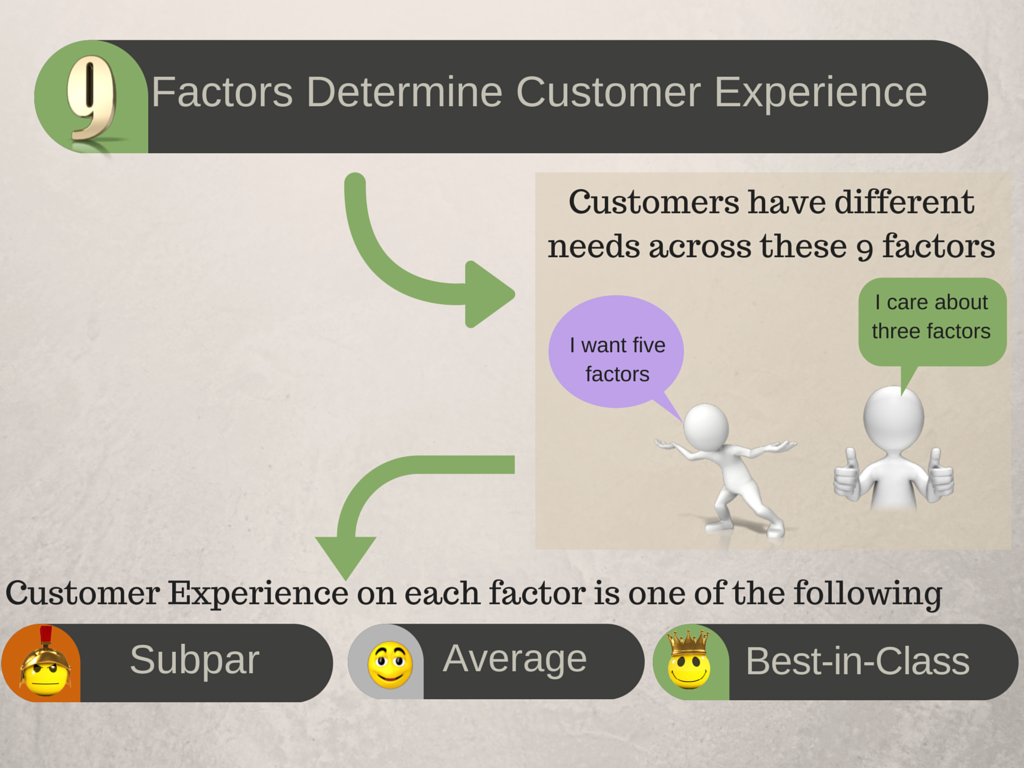





The above slide show gives you a brief overview of this topic, while the blog below gives longer narrative. Download a free chapter from my book for even more details.
Many of us have had customer experience horror stories, either that of your cellphone not working when you have a flat tire, or that of being stuck at an airport for hours or many other such situations. After each of these situations we wonder if the company cares about us as a customer and do they really need our business.
On the other hand, companies are trying to solve the puzzle related to delivering best-in-class customer experience. They have leadership roles focused on “Customer Experience” and have it as part of their core strategy. They are hoping to solve this puzzle and become a brand loved by customers.
So how should a company solve the customer experience puzzle in a way that is easy to understand, some way that would help them differentiate themselves against the competition.
Here is a “Customer Experience Framework” with nine key factors that drive that experience. This framework is applicable across many industries as demonstrated by the examples below.

Companies should map the customer experience they deliver on these nine factors against their competitors. Doing this will tell them if they are best-in-class, ordinary or sub-par on that particular factor.
Customer Experience Framework
- Requirements: Different customers have different needs and constraints. Product/Service that meets those needs while conforming to the constraints delivers good experience on requirements. Companies usually tend to overshoot on the customer requirements, which enables them to serve many diverse customer segments with one product. This is good unless there is a conflict with the constraints. An example of customer requirements for a television is 1080p, 3D, HDMI outputs, LED, 60″ etc…
- Price: This is one of the key factors of customer experience, as it defines the value that the customer is able to derive from the product. For a Wal-Mart shopper, low prices deliver the right kind of experience. While Neiman Marcus prices deliver the right kind of customer experience to high-end luxury shopper. So this factor varies by the customer segment being served.
- Availability: Many companies ignore this factor but this is one of the key drivers of customer experience. This is driven by availability of your product/service when the customer needs it the most. Your customers rely on your products/service for their needs, and not being available drives a bad customer experience. For example, availability of mobile network when a customer wants to make a phone call. Similarly, availability of e-commerce websites that offer the right product when the customer is looking to buy.
- Convenience: This factor determines how easy is it to use your product/service in different situations. The easier it is to get access to and use in different situations the better is the customer experience. A good example of this would be Google search, as it is easy to use search engine that delivers good results consistently.
- Service/Support: Post-sale service/support, which is essential in many industries. Different methods of delivering service/support are available and accepted for delivering the right customer experience. But one aspect that remains key is the time spent for initial contact and satisfactory resolution. Insurance companies carefully measure their performance on delivering this customer experience. Many of these companies are making it easier to file claims and the resolve claims at a fast pace.
- Quality: Imagine your television breaks down right in middle of an important game, quality is an essential part of customer experience and it hurts companies over a long run when product quality is sub-par. And example of a company delivering good experience on this dimension is BMW. With their 48K and 4 year full service maintenance program they have taken out quality fears from a complicated machine which has many parts that can break.
- Fashion: This is the “Cool factor”. This requires meeting customer requirements in a way that amazes the customer. Apple iPhone comes to mind as an example, but I would like to give one from semiconductor industry. NVIDIA and AMD are fierce competitors in the graphics card market, they keep delivering cool products year after year to amaze and capture the gamer market. Graphic image quality and the speed of rendering keeps improving every year. I tag this as fashion as the trend keeps changing all the time. The most cool thing today might be outdated tomorrow, as experienced by Motorola RAZR.
- Social Responsibility: This has to do with the social impact the company is making either through its product/services or as a corporation. A socially responsible company that makes a social difference in the minds of its customer base delivers good customer experience. An example is Nike and the effect of the child labor issue on its business. Also, Toyota’s efforts to convince the American customer that their cars create jobs in US.
- Brand: All companies have some brand value that gives the customer the level of comfort required for doing business with that company, hence driving the customer experience. This is the most important factor of all as it carries the fruits/burdens of good/bad customer experiences across the other eight factors. For B2C focused companies this customer experience is associated with the company, for B2B focused companies this experience is a function of individual relationships and company brand.
Companies that focus on just one of these nine factors seldom survive, and it is impossible for a company to be best-in-class at all nine factors. But a good company is best-in-class on 3 – 5 factors. The company might or might not choose to focus on the other factors. Depending on the factors they choose, they define the customer segment they attract and the financial benefit they derive from those customers.
Let me know what you think about the customer experience framework.
Would like to read more details about these factors? Read a free chapter from my book describing these factors.


[…] « Customer Experience: Nine factors that impact customer experience […]
[…] this while being cash flow positive. This is an exciting story and hence I am going to use “Customer Experience Framework” to evaluate their […]
[…] of working on many innovative projects. And I would share one such experience to show the impact of customer experience framework on […]
I love the thinking behind this article and provides a great tool for benchmarking and identifiying areas that need improving. What is the exact method you would use to carry out this research? Do you simply ask the question how well do we do in each area and do you provide background on the definition of each area?
And how would you find and question competitors customers?
Thanks for a great article
Thanks for the comment Adam,
Over the next few weeks I will blog about ways to gather information related to “Customer Experience Framework”. Would love to hear your thoughts on those blogs as well.
[…] customer analysis (using the customer experience framework) to understand the experience delivered by current solutions. Based on current customer experience […]