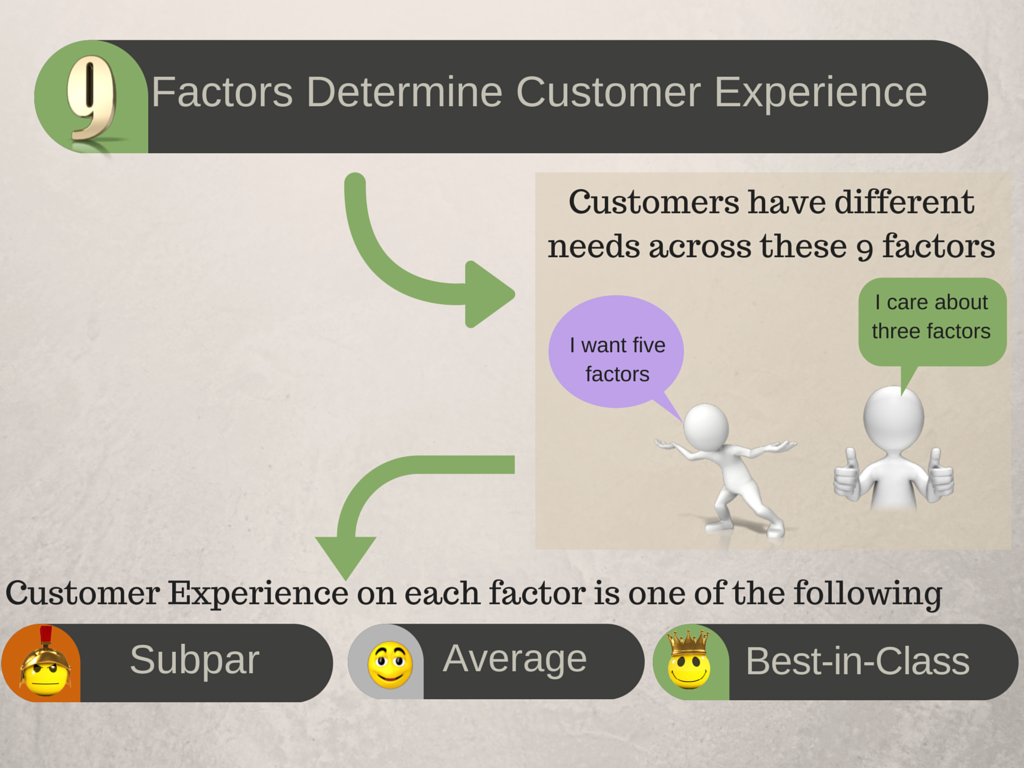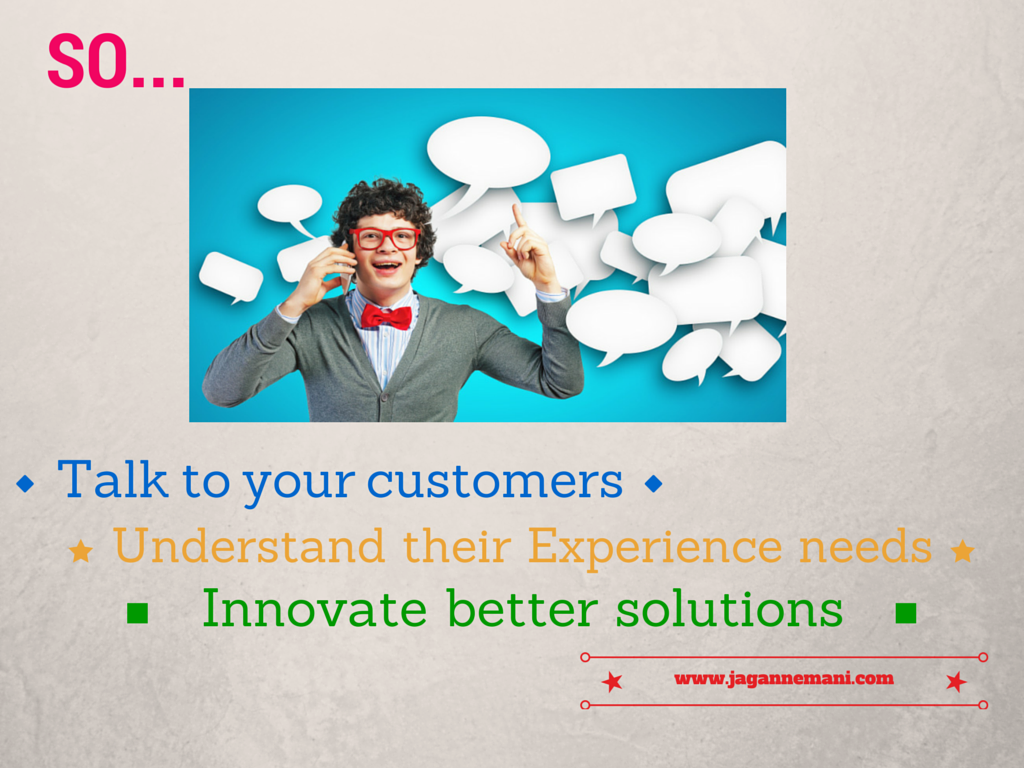
Thank you for your interest in the innovative nine factor customer experience. You can learn all about this framework by downloading this free chapter.
Happy Reading.
Permanent link to this article: http://www.jagannemani.com/2013/05/15/customer-experience-framework-free-chapter-download/
Jun 14 2012
Long ago, when I was interviewing for a consulting job, I had to learn the consulting speak. And one of the cliché in that consulting speak was “delivering value to clients”, which when used would signal to my potential employer that I am “client ready” and ready for the job.
“Delivering Value to Clients” is part of the core strategy for many consulting companies, it was the core theme of most meetings, it was even part of employee evaluations.
But what does it really mean? Can we measure it easily and consistently? Is there a metric that indicates if we have delivered value?
In my opinion, the value delivered to a client is always subjective, as it varies by the situation and by the client. In some cases, clients realize immediate ROI from all the work done by the consultants, and hence value is delivered. In others, it takes years to realize the value and by then everyone has forgotten the consultants. So it is not easy to find value in consulting assignments, even though clients and consultants spend weeks together solving a problem.
Similarly, “Delivering Value to a Customer” seems to have become the cliché within product and service companies. Measuring the value delivered is even more difficult when the company and customers do not interact face to face. Because value is not a simple variable that can be measured easily, but a result from a complex equation that include many variables.
Let me share an example from my experience to show the complexity related to delivering value. I was analyzing the reasons for customer attrition with one of my products, and found that “Price Value match” was often stated as a reason for customers cancellations. To understand this better, I called those customers to discuss the reasons for cancellation. I would also call some of the happy customers to understand the value they got from the product. Below are my findings on “Delivering Value” to the customers:
1) Value is a complex equation: It has Price on one side and other aspects of the product (like functionality, ease of use, quality, service/support, warranty) on the other side. It is never easy to objectively measure the value delivered to a customer, but there are ways to subjectively decide if the customer is getting enough value from the product (such as, by measuring Net Promoter Score).
2) Even free products need to deliver value: For free products, Time is used in place of price to measure value. Only those products that justify the use of customer’s time deliver good value.
3) Factors that contribute value vary by customer and by situation: Every customer values different aspects of the product differently. Some customers value customer support more than any other aspects of the product. While others value ease of use or quality more. Every customers uses the product in different situations and in different environments, and the value a product delivers to the customer in those different situations is different. Hence traditional customer segmentation methods (those based on size or geography) do not apply when trying to measure value. Rather companies should focus on the job that the customer is trying to do and see if the product improves their ability in doing the job (i.e. delivers value)
4) Mental Calculations of value: There are no systems to help the customer objectively measure the value they get from a product, so most customers do these calculations in their heads. After buying a product, customer place a value per use and mentally try to figure out how many times they need to use the product to recover the price they paid. If this mental calculation is reasonable, they continue to use the product. This mental calculation is tough on subscription model businesses, where customers pay a fee every month for using the product or service. This is because the customer is comparing what they got every month for the fee they pay that month. If they feel that they are getting enough value, they continue with the subscription if not they cancel their subscription.
5) Customer experience is key to delivering value: The customer experience delivered by the product helps in determining the value of the product. Functionality of the product, ease of use, quality, reliability and support all play a vital part in delivering value to the customer. All these factors are not equally valued by the customer, hence it is important to understand what the customers value and deliver that customer experience.
In summary, delivering value is a complex undertaking and companies that focus on this as a strategy find it challenging to measure or deliver value. They should rather focus on tangible aspects of customer experience as it will make sure that the customer gets what they need, i.e. good experience. This will help the company in winning more customers and market share in the long run.
Permanent link to this article: http://www.jagannemani.com/2012/06/14/better-customer-experience-delivers-better-value/
May 22 2012
There are many factors that contribute to superior customer experiences…out of the following 10 choices, which do you consider to be the top three drivers?
Think of a recent experience that you had as a customer and make your choices. You can see the results of the poll after your “Vote”.
Share your opinion and learn about the Biggest Drivers of Customer Experience.
Permanent link to this article: http://www.jagannemani.com/2012/05/22/biggest-drivers-customer-experience/
Mar 26 2012
This is an updated blog post on the customer experience driven innovation story of Fab.com.
In January 2010, Jason Goldberg and Bradford Shellhammer launched Fabulis.com, a social networking website for gay people. The initial vision of the founders was to become Yelp, Groupon and Facebook for gay people. Jason Goldberg was a successful serial entrepreneur who had successfully exited a couple of ventures before and Bradford Shellhammer was good with design. They both launched this social networking website which managed to attract 110,000 total customers and about 30,000 active users. Though they built a good website, Fabulis.com did not deliver a differentiated customer experience compared to Yelp, Groupon or Facebook, so gay people did not feel the need to use this website.
By early 2011, the founders realized that they need to do something different. So they shut down the site in order to develop a newer, un-served niche where they could be much more successful — one based on design. In June 2011, they launched Fab.com, a flash sales website (i.e. a site that offers products at deep discounts for a limited time) for the fashion-oriented customer segment.
When Fab.com decided to move away from the gay market to a flash sales market, they entered an overcrowded marketplace with players like amazon.com, branded retail stores/websites, and many flash sales websites. All these retail outlets offered price discounts and had spent a lot of money to attract customers to their sites/stores. So how could a start-up compete against these seasoned incumbents? Fab.com did so by focusing on delivering a customer experience that was different from any other retailer.
Online/Retail shoppers have different expectations based on what the shopper is looking for and the time of the year. During holidays they want a wide choice of gifts at throw away prices; at times like Valentine’s Day they want to find cool surprises. And throughout the year it is about finding the items that they need at a reasonable price or with a memorable customer experience. Retailers and websites that have successfully differentiated themselves on the customer experience they deliver have seen repeat customers.
In order to understand how Fab.com differentiated itself in the overcrowded retail space, let us compare them with the customer experience delivered by other types of retailers in a variety of shopping situations.
High-end retailers, like Niemen Marcus or Louis Vuitton, attract shoppers who are looking for specific high-end fashion products. Over the years these high-end retailers have improved their ability to attract and sell to both impulse shoppers and fashion oriented shoppers by delivering a good customer experience. They meet customer requirements by providing them the products they are looking for; hence the requirements aspect of customer experience is high. They make it convenient for the customer to shop in their stores, provide good service, and deliver high quality products that are very fashionable. So these high-end retailers score high on convenience, service/support, quality and fashion. They cannot guarantee that the specific item that the customer is shopping for is available in the store, but they can get it shipped to the customer’s home through their online stores. Hence they typically rate as “medium” on availability aspect of customer experience. The customer experience delivered by these high-end retailers is shown in the figure below.
Customer Experience delivered by High-end Retailers
Now let’s review the shopping experience delivered by online retailers like Amazon.com. The key to Amazon.com’s success is to deliver a customer experience that makes the customer think of them first while shopping online. They are focused on attracting customers who know what they want, and are looking to buy soon. So they make sure that they have what the customer is looking for, at the right price, in a convenient online location, and with reasonable customer support. They have a variety of items available, from books, toys, electronics, games, watches etc. But the primary factors that they differentiate on are Price, Convenience and Availability. The price factor is very important for online shopping and they deliver this by making sure that the prices of items sold on Amazon.com are highly competitive. Amazon.com makes it convenient for customers to find the products they want to buy through a very efficient search engine. Also they have a good recommendation engine which suggests products to the customer based on the buying history of other similar users. These coupled with free two day shipping for Prime customers, and free regular shipping for all customers on most items, make it convenient for the customers to shop at Amazon.com. The customer experience delivered by Amazon.com is shown in Figure 4 below.
Amazon.com Customer Experience
Between the high-end retailers and Amazon.com, fashion, convenience, price, service/support and quality aspects of customer experience have already been covered. So how could Fab.com differentiate itself from Amazon.com and these high-end retailers by offering something new to fashion oriented customers?
First and foremost they achieved this by focusing on design, delivered through an attractive website that offers cool products with high visual appeal to fashion-oriented shoppers. Visitors to Fab.com are not necessarily looking for a specific item; they do, however, want access to some cool, visually appealing products they wouldn’t find anywhere else. Every day at Fab.com, customers can find wide variety of products including artwork, jewelry, and designer furniture with prices ranging from $1 to $1000+. Fab.com does not restrict itself to a core set of designers; rather it offers any product that has cool design that would appeal to its customer base. This kind of variety is difficult to find in high-end retail stores, which is how Fab.com offers more to its customers.
Fab.com also offers deep discounts for limited time, which tempts customers to make impulse purchases. These discounts include their daily sales of up to 70%, with most prominent discounts in the 25% to 45% range. These sales are offered for 72 hours and shoppers see a counter on top of each product page that creates an urgency to buy. Also, when the customer adds the item to the shopping cart they have 15 minutes to make the purchase. After 15 minutes the item is automatically removed from the cart. This creates a sense of urgency for the customer, and helps the impulse buyer to make that purchase.
It is great to offer fashionable products at deep discounts and get impulse buyers to make that purchase. But for a business to be successful and attract enough paying customers, it needs to satisfy the customer experience across at least three factors. And this is true for Fab.com as well, as it needs customers to visit its website and trust it to share their credit card information with the website. Also, since a website creates a sense of urgency for buying the products it is essential for customer to trust the company for making the purchase. This is where the need for a strong brand comes in for Fab.com, and the founders did a great job of building the brand within a limited budget.
Before launching the website Fab.com signed up about 175,000 customers through various viral marketing activities and strategic advertising. This ensured that the sellers were willing to sell the products at Fab.com as the site had a decent customer base. Fab.com built social sharing capability within the website and encouraged their customers to share their purchase information with their friends on social networks like Facebook. Many customers were happy to share the information about the cool products that they bought at Fab.com. This created further brand recognition and attracted more customers to the website.
After getting an initial set of customers and modest success, Fab.com founders shared their story of converting a failure to success with media and on social media. This topic is of interest many people and after reading about this success story people started exploring Fab.com. Blogs, news articles, presentations, videos, twitter feeds and Facebook shares went buzzing with the Fab.com success story. This created global brand value for Fab.com, and they saw their customer base increase exponentially. Within seven months of launching the website, Fab.com had two million subscribers with about $200,000 daily sales on average.
Fab.com Customer Experience
The above picture depicts the customer experience delivered by Fab.com, which is high on three factors Fashion, Brand and Price. It is not a website that customers visit when they want to buy a specific product as that product might not be available on the website. Fab.com does not store any inventory, and it passes the order out to the seller for fulfillment. This leads to long delays in shipment of the orders. Most customers expect an ecommerce website to have the products they need and ship it to them as soon as the order is placed. So Fab.com does not meet the requirements of online shopper and hence scores low on requirements aspect of customer experience.
The site conducts product flash sales for 72 hours, and after that the product might not be available. Also, there are limited quantity of items available for sale, hence Fab.com scores low on availability. Lack of search engine to search for products, brand names or designers make it less convenient for the customers, hence it scores low on convenience aspect of customer experience. Long wait times for receiving the product without a way to track the true status of the order and no return policy make Fab.com score low on support/service. Like many online retailers it would be difficult for Fab.com to control the quality aspect of the product as it is really the experience delivered by the seller. Hence it scores low on quality aspect of customer experience as well.
Overall Fab.com has experienced good growth and profitability by focusing on three aspects of customer experience (Price, Fashion and Brand). But to continue growing it would need to offer better customer experience across a few other factors as well.
Fab.com is a great example of how innovative companies can be successful by delivering good customer experience on just three factors, the minimum number required for achieving customer attention. Similarly, innovative companies looking to differentiate themselves in a crowded marketplace should figure out the three factors that can help them differentiate and deliver good experience across those three factors.
Permanent link to this article: http://www.jagannemani.com/2012/03/26/fab-com-customer-experience-success-story/
Feb 27 2012
In early 80s a new deadly disease came into existence, first in some gay men, then in injection drug users followed by users of blood related products. Most of the patients affected by this pandemic has suppressed immune systems and were falling severely sick with diseases that people with a decent immune system would never get. This caused alarm for National Institute of Health (NIH) and they started funding research projects to figure out the basic science behind the disease which we refer to as Acquired Immunodeficiency Syndrome (AIDS). They demonstrated that Human immunodeficiency virus (HIV) causes AIDS and funded basic and clinical research to discover drugs that could treat the HIV infection. They have also funded clinical trials to figure out the drug combinations for slowing down, halting and preventing the HIV infection.
Over the last three decades, NIH has had phenomenal success in fighting one of the biggest pandemic of our lifetimes. And when it started on this mission, its primary focus was not to wipe out the disease, not the price points at which it can sell the drug and definitely not making a blockbuster profitable drug. Its primary focus was to provide baseline cure that would enable us to slow down the progress of the disease and its impact on our society. The primary target customer for NIH supported research institutes and private companies working on HIV drug research was Food and Drug Administration (FDA), as they had to get FDA approval for releasing drugs that could slow down the progress of HIV infection. Drugs were quickly approved by FDA, even if the drug had minimal impact on HIV infection. Social need for baseline cure to HIV infection was the single most important focus of all the players in the ecosystem (NIH, research institutes, private companies and FDA). Hence FDA’s customer experience expectation was as depicted in the figure below:
FDA had the social responsibility to provide baseline cure for HIV infection and hence it had such high social responsibility expectation. It relied on NIH funded/supported research to help discover the drug and hence its expectation was high on brand. Its focus initially was not to eliminate the pandemic but to take the right steps in slowing down the impact of HIV infection. So it was fine with approving any drug that had minimal impact on the infection but with sufficient quality, hence the low to medium impact on requirements and quality. And FDA wanted to make the drug available to a contained population of AIDS patients so that it can understand the impacts of the drug further, which ranks the availability factor between low and medium.
This type of social responsibility based customer experience is not uncommon in pharmaceutical industry, rather this is what makes treatment for many non-common diseases possible.
Permanent link to this article: http://www.jagannemani.com/2012/02/27/social-responsibility-focused-innovation-in-pharma-industry/
Jan 31 2012
Have you heard of an entrepreneur or visionary who believes in a methodical process. Well there are very few of those, but many visionaries do not believe in process. They rather figure things out and get them done. Process for them is bureaucracy which just delays work without adding much value.
Many of these visionaries start projects without performing required due diligence. Many of them realize mid-way through the project that it is not as attractive as they first thought, as a result wasting a lot of time and resources.
This blog is about a structured innovation process that will help innovators in evaluating ideas at the rapid pace and investing their limited resources in ideas with good market potential. The innovation process described below is a disciplined process that will help innovators discover potential problems well ahead of time and help them fix the problems before making serious investment into the idea.
Iterative innovation process described above evaluates various aspects of the idea at varying levels of detail through each iteration.
Evaluate phase (iteration#1):
This is a very quick evaluation phase which needs to completed in short time. The goal of this phase is to quickly test the opportunity and decide if there is merit to investigate this opportunity further. Use secondary research methodologies to perform high level analysis on customer, strategic, financial and commercial viability of the idea.
Perform customer analysis (using the customer experience framework) to understand the experience delivered by current solutions. Based on current customer experience and customer expectations, a new target customer experience model is developed.Strategic analysis involves analyzing the companies intent and ability to provide the new target customer experience. Some of the questions answered during strategic analysis are: Does innovation enhance companies position in the market? Does the company have the tools/skills required to deliver the target customer experience?Perform financial analysis to understand the market opportunity and revenue potential from pursuing the opportunity. Conduct commercial analysis to understand how the product/service will reach the customer. Does the company have the right ability and structure to deliver innovation to its customer? Or do they have to partner with some others to deliver the right customer experience?
Once the analysis is complete “Go”/”No-Go” decision is made on this innovative idea. If the idea has merit to do further analysis it moves into the “Explore” phase.
Explore phase (iteration #2)
During explore phase the ideas need to evaluated in greater detail by analyzing data/customer inputs from outside the company. Primary research is the focus on this phase, which requires the innovator to gather as much external data and feedback as possible. Customer surveys, one on one customer interviews and job shadows are some of the methodologies used in this phase to understand customer experience factors. Develop competitive analysis along with 3 – 5 year strategic road-map in this phase to see if the idea fits into the strategic road-map. Gather cost information throughout this phase to understand the financial impact of providing different customer experience. Based on the cost and revenue analysis, develop a financial model focusing on net profitability. Draw sales and marketing plans and test them to figure out the commercial viability.
At the end of this phase a detailed plan on how to win the market is developed, and “Go”/”No-Go” decision is made. Based on the size and maturity level of a company, you might want to stop after Explore phase. For example, entrepreneurs might want to stop after this phase and focus on building the innovation. While bigger more mature companies should take it further to “Examine” phase.
Examine phase (iteration #3)
This phase is about making sure all the details related to innovation idea are flushed out. During customer analysis, focus on gathering all the requirements from the customers. Conducted focus groups, solution jams or outcome based surveys to understand the exact customer experience that would help you win over the customers. Get customers to force rank their requirements and do some price sensitivity testing to understand their willingness to pay. For strategic analysis, make sure that the innovation idea has a home once it is developed. Find the right organization and a good leader who would take P&L responsibility for the innovation idea. For financial analysis build a detailed cash flow statement that highlights the break even periods, investment requirements and expected ROI. Conduct some sensitivity analysis on the different assumptions and paint worst case, average case and best case scenarios. For commercial analysis, get your sales team on board and figure out the overall sales targets. You would also need to determine their compensation model and any accelerators for pushing the innovation idea into the market.
The three iteration approach presented here is a well-tested process that would help in testing out the innovation idea. If any idea withstands the test of all the three iterations and still looks good, it is an idea worth investing.
Permanent link to this article: http://www.jagannemani.com/2012/01/31/innovation-process-essential-discipline-for-innovators/
Jan 12 2012
During my consulting years I had the good fortune of working on many innovative projects. And I would share one such experience to show the impact of customer experience framework on innovation.
This project was with a networking equipment manufacturing company (makes switches, routers etc for businesses). We were engaged to develop the right strategy and business model to take away the market share from the market leader (800 pound gorilla).
I started by analyzing the market and understanding the customer experience delivered by each player. Given that it was a B2B (business to business) market with long sales cycle, I needed to understand the primary drivers of customer experience. So I immediately plugged myself into an inflight sales opportunity and learned that meeting customer requirements and having a good quality record was table stakes. The next best factor was brand value of the company and the relationship that customer executives had with networking equipment vendor sales staff. Without meeting these three factors, networking equipment vendors were not even invited to the table for discussion.
My client scored high on these three factors and hence was invited to bid. The next factor that customers evaluated vendors on was price. Now this factor had many aspects to it like street price, discount%, yearly service fees, financing options, leasing options, terminal value at the end of a lease etc. Using these different components many different versions of the price were presented, reviewed with the customer and iterated upon. And when we were convinced that we had the best price factor we submitted the proposal.
Unfortunately, my client did not win the deal as the market leader had better relationship with the customer and had more financial levers that provided better price related customer experience. It quickly became clear to me that we could not win on any one of the above factors (Requirements, Quality, Price and Brand), and we need to deliver better customer experience on some other factors. My client’s customer experience and that of the competitors is below.
Given that it was a big B2B transaction for networking equipment, availability can be planned and executed on. Service/support is part of service level agreement, so it was not possible to differentiate highly on these factors. Fashion and social responsibility do not have much of an impact on big B2B sales. So only factor that was left was convenience, and we thought hard about ways to deliver better customer experience on the convenience factor.
Then it dawned on me that accounting for expensive networking equipment is a pain, especially when the expense hits the balance sheet. Also, asset tracking is a big pain point which requires tracking and reporting the status of the assets on a quarterly basis. These pain points were created because of US accounting requirements, and big customers were facing lot of costs/risk due to these requirements. Also adoption of international FASB accounting rules was going to elevate the pain further.
To address these pain points we designed a “Networking Equipment Subscription Program” that would allow customers to get equipment on a monthly basis without any contracts or penalties. In this program the equipment is not owned by the customer, so it does not show up on the balance sheet and they do not have to track and report it. They just have to make sure that they keep making monthly payments for the time period they use the product and return the product when they do not need it anymore. This was designed to make it convenient for customers to procure and use networking equipment, customer experience graph is show below.
Given that this program delivered better customer experience by making it convenient for customer to account for and manage the assets, this program was successful on launch and we were able to beat initial sales estimates by 100x.
Since our goal was to make it convenient for customers to procure and use networking equipment, we learned about some issues with the business model that would make it less convenient for certain segment of customers. Having learned about those issues we were able to proactively fix the issues and win big business deals within those segments as well. For example, hosting providers found it very inconvenient to rip the equipment of the network and ship it back when it is not being used. Given the variations in their network usage, they wanted the convenience of having the spare capacity. But they did not want to pay for spare capacity or return the equipment. To solve this problem, the business model was further adjusted to make sure that demand and supply were tightly matched and the risk of unused capacity was minimized.
By focusing on a differentiating factor of customer experience, we were able to build a strong business that was successful at launch.
Permanent link to this article: http://www.jagannemani.com/2012/01/12/innovation-focused-on-customer-experience/
Dec 27 2011
There was time when airline travel was comfortable and convenient, with free luggage check-in, free drinks, free food and in-flight entertainment. Airline Industry customer experience has changed significantly since, and is a prime case study on how customers’ adapt to changing priorities of companies.
For US Airline industry, the priority has changed from delivering good customer experience to being financial sound. Unfortunately, this industry wide priority change has hurt customer experience and forced customers to reconsider their expectations. The purpose of this blog is to analyze the customer experience delivered by different airlines, using the “Customer Experience Framework” (read about the framework here).
When it comes to customer experience there is hardly much differentiation across the major US Airlines (except Southwest). Airlines segment their customers into preferred customers and regular customers and deliver different customer experience to both segments. Customer experience map for preferred customers is below:
Preferred Customers with loyalty programs get high brand experience from the airlines. Associated with this high brand experience is better convenience and better price. These customers do not pay extra for better seats, check-in luggage, standby flights, preferential boarding or even upgrades. These additional perks make it convenient and cost-effective for preferred customers to travel with just one airline. On top of Brand, Convenience and Availability, the top airlines do meet customer requirements as they are able to fly customers from place to place. Also, they offer good availability through their own fleet and their partner networks. So the top airlines do well across 5 factors for their preferred customers.
But with Regular customers, the customer experience delivered by these major airlines is completely different as shown in the figure below.
For regular customers, airlines deliver the same experience across Requirements and Availability factors. But they do not deliver other experiences that are reserved for their brand loyal customers. Hence the customer experience for regular customers is strong across three factors (i.e. requirements, availability and brand). Based on this experience, regular customers do not have any incentive to fly with one airline and they shop for the best combination of price & convenience (direct vs. 1/2 stops).
In summary, major airlines deliver good customer experience across 5 factors for preferred customers and across 3 factors for regular customers. Given the distribution of their customer base across preferred and regular customers, they are able to deliver this customer experience while aligning well with their current financial priorities.
Discussion about airlines industry will not be complete without discussing Southwest Airlines, figure below depicts Southwest’s customer experience chart.
Given their business model it is difficult for Southwest to differentiate customer experience for their preferred and regular customers. Their customer experience is focused on price, as they do not charge any additional fees for luggage, standby, change fees etc. for any of their customers. Also, their boarding process is based on first come first serve basis (though preferred customers do get the “A” boarding) which does not preclude a regular customer for getting into the plane first and occupying convenient exit row seat. So Southwest delivers good customer experience across Brand, Requirements and Price for all customer segments. Given the lack of extensive partnership and limited airports that Southwest serves, it falls short on the availability aspect, and service/support is no different than the major airlines.
Based on the customer experience maps for these major airlines, there is opportunity for other airlines to deliver better experience across other factors and build a business model on that experience. Please let me know of what your think about airline industry customer experience.
Permanent link to this article: http://www.jagannemani.com/2011/12/27/airline-industry-customer-experience/
Dec 22 2011
My last blog described a new “Customer Experience Framework” (read it here), that companies could use to understand their customers’ experience. In this blog, I use this framework to illustrate the affect recent Netflix fiasco had on customer experience.
In 1990′s Blockbuster used to dominate the video rental marketplace. They had shops that were conveniently located in many neighborhoods and rented good quality movies . Figure below depicts the Customer Experience delivered by Blockbuster during that time period.
Blockbuster was really strong on four dimensions of customer experience, Requirements, Price, Quality and Brand. Blockbuster met customer requirements by having a wide genres of movies available for diverse customers. The price of renting a video was less than the price of watching it at the movie theater, which greatly appealed to families. They made sure that video quality was good. And Blockbuster built enough trust and brand value to support its place in the market. Though the above four factors were working well for Blockbuster, a few factors went against it. For one it was not convenient to rent or return movies from Blockbuster. Rain or snow, renters had to make sure that they drop the movie back on time or they were charged a late fee. Second, availability was a suspect, as the movie that customer wants might not be available. Third service was weak as customers had to wait in long lines during typical renting periods (i.e. Friday nights). These three factors caused enough bad customer experience for Blockbuster’s customers. But since Blockbuster offered customers good experience across four important factors customers continued to rent movies from Blockbuster.
Enter Netflix, after a few trials at their business model in early 2000 Netflix started flat monthly fee unlimited rentals with no late charges or due dates. Every customer could check out three DVDs at once which would be refilled with movies in the queue once any DVD was returned. Figure below depicts the customer experience delivered by Netflix during its initial days.
Though Netflix did not have much Brand recognition, it made sure that it competed on 4 other factors of customer experience, i.e. Requirement, Price, Quality and Convenience. Netflix started offering a good selection of good quality movies across diverse genres. They made it easy for the customers to rent and return DVDs from Netflix, as the DVDs showed up at customers’ door steps. They made sure that customers’ monthly cost of movie rental remained flat and customers were not penalized for not returning the movies on time, which made them better on price dimension than Blockbuster. So frustrated Blockbuster customers started switching to Netflix as now there was an alternative that could offer them better customer experience.
As Netflix started getting more customers, it added brand factor to the customer experience (i.e. customers could now trust Netflix with their credit cards and their information). But pretty soon Netflix realized that they had left the Availability gap in their customer experience. There were some smart customers who maximized their 3 DVDs, with two DVDs in transit (one outbound and one inbound) and one always available for viewing. But not all customers are smart, so many ended up having 3 DVDs with them at once and no DVDs for a next 3 – 5 days. This availability problem could have hurt Netflix, but they plugged it by offering online streaming for a few more dollars per month. So Netflix’s customer experience chart looked something like the figure below.
Now Netflix delivered strong customer experience over six factors, Requirements, Price, Availability, Convenience, Quality and Brand. They also did a decent support job that enhanced the customer experience. This level of customer experience changed the rental landscape and Netflix grew to become a market leader. At the same time, Blockbuster struggled to deliver the right customer experience, started losing customers and struggled financially.
But delivering strong customer experience across six factors and decent customer experience across one more factor is not easy. Netflix realized this in mid 2011, when they saw the financial strain of delivering this customer experience. Given that their main competitor was out of business, they tried to redefine their customer experience. They increased prices by ~60%, and planned to separate their online and DVD by mail businesses into two separate businesses. This would need customers to create two different logins (one with Netflix and other with DVD by mail business Quickster), and keep up two different accounts. Due to customer outrage they backed off from their plans, but had they gone ahead with plans their customer experience graph would have looked like in picture below.
By increasing the price, Netflix is delivering some bad customer experience as customers are forced to pay a price point that is higher than what they have been paying for years. But separating online and DVD offering, they would have recreated the availability problem. Not all movies/shows are available online and managing the flow of DVDs requires some smart management. Having two separate accounts with two different companies with no customer data sharing between both would have made it really inconvenient for the customers as well. Also parental control that is not easy to use and inability to group/show list of recently watched movies creates a convenience barrier.
Though Netflix has backed off its plan to separate the business, the increase in prices has forced many customers to choose just one service. Because of this forced choice, Netflix is delivering the customer experience a depicted in the picture above. It is strong across 3 factors (Requirements, Brand and Quality) and decent enough on 2 other factors (Service/Support and Convenience). But as the downfall of Blockbuster thought us that being good on 3 factors is not good enough. So customers have to wait for Netflix to improve its performance across more factors or wait for an innovative company to disrupt video rental marketplace.
Please share you thoughts about this blog and “Customer Experience Framework“
Permanent link to this article: http://www.jagannemani.com/2011/12/22/netflix-saga-a-customer-experience-perspective/
Dec 20 2011
Many of us have had customer experience horror stories, either that of your cellphone not working when you have a flat tire, or that of being stuck at an airport for hours or many other such situations. After each of these situations we wonder if the company cares about us as a customer and do they really need our business.
On the other hand, companies are trying to solve the puzzle related to delivering best-in-class customer experience. They have leadership roles focused on “Customer Experience” and have it as part of their core strategy. They are hoping to solve this puzzle and be that customer loved brand.
Though both customers and companies are focused on customer experience, it often feels as both are digging a tunnel from both ends, one that would not meet in the middle.
So how should a company solve the customer experience puzzle in a way that is easy to understand, some way that would help them differentiate themselves against the competition.
Here is a “Customer Experience Framework” with nine key factors that drive that experience. This framework is applicable across many industries as demonstrated by the examples below.
Companies should map the customer experience they deliver on these nine factors against their competitors. Doing this will inform them if they are best-in-class, ordinary or sub-par on that particular factor.
Customer Experience Framework
Companies that focus on just one of these nine factors seldom survive, and it is impossible for a company to be best-in-class at all nine factors. But a good company is best-in-class on 3 – 5 factors. The company might or might not choose to focus on the other factors. Depending on the factors they choose, they define the customer segment they attract and the financial benefit they derive from those customers.
Let me know what you think about the customer experience framework.
Permanent link to this article: http://www.jagannemani.com/2011/12/20/customer-experience-nine-factors-that-impact-customer-experience/
Dec 12 2011
Many books and innovation speakers talk about importance of customer feedback during innovation process. They believe that building something without customer feedback is like gambling, the results are often not predictable and most innovations fail. Innovation success rate across all industries is around 4%, and there are a few preachers who believe this will be improved by gathering lots of customer feedback before building the product.
While there is some truth to that and customer feedback is very useful in many cases, it does not necessarily help innovation in all the cases. And this is because of gaps in customer knowledge, something that I am calling “Customer Knowledge Chasm”
For example, before iPhone disrupted the smart phone market, there were many researchers/innovators working on figuring out the way to combine mobility and internet together. There were a few incremental/sustaining solutions that worked just fine. During that time, many customers were not able to describe how best to make mobility and internet work together.This is because majority of the customers are not visionary, and current products/solutions are their frame of reference. So for them it is very difficult to break away from this frame of reference and think of something that is completely disruptive. Hence “Customer Knowledge Chasm” exists, as described in the framework below.
Many of the customer touch points help with Incremental and Sustaining Innovation, few examples described below:
And there are many such customer research methodologies that offer insights/knowledge within current product frame of reference. Many of these customer research methodologies run into “Customer Knowledge Chasm”.
There are ways to avoid “Customer Knowledge Chasm” and it is done by understanding the job that customers are trying to get done, the process that they follow and the ideal outcomes they would like to achieve. By focusing on jobs, process and outcomes, we do not have to rely on customer knowledge and hence avoid the chasm. Innovating to improve the outcomes of the job also ensures that product is relevant to the customer and they would buy if we build.
In a future blog I would share more information about Jobs/Process/Outcomes methodology. Please share your thoughts on this blog.
Permanent link to this article: http://www.jagannemani.com/2011/12/12/customer-knowledge-chasm-barrier-to-customer-feedback-on-disruptive-innovation/
Dec 03 2011
Having a prototype makes a big difference in market research, I knew of this before but it learned this again during recent customer visits. So here is a blog presenting my learning around “Power of Prototype”.
Background:
The best way to present this is by telling a tale of two ideas; to maintain confidentiality I would call them idea #1 and idea #2. Idea #1 is a new idea for us and for our customers, something that will create a product category. Idea #2 is new to us but there are products out there that serve the purpose.
Over the last few months I have talked to customers about the two ideas to gauge their interest and gather their requirements. I did two rounds of customer research. During first round, I visited few customers and discussed the innovation ideas and their requirements. The goal was to gather enough information that would help us in doing a deeper market research.
During second round, I invited a few customers to a “Solution Jam” and facilitated discussion about the ideas. The goal here is to get customers to tell us what they want from the product and will they buy if we build it. Overall expectation is to get higher customer interaction as we move from round 1 to round 2, which helps us in clearly defining the products. With this as a background, here is what happened during those customer research rounds.
Customer Research Round #1:
Idea #1: We had a good working prototype for this idea and I was able to quickly demo this prototype to get the discussion started. Many of the customers sat on the edge of their chairs and provided me with a lot of inputs about product functionality. Given that this is a new product for us and for our customers, it was exciting to see that customers had so much to share. And this level of excitement and feedback was consistent across all customer interviews.
Idea #2: We did not have a prototype for this, and we shared block level diagrams and got good feedback from the customers. Since there were other products in the market that somewhat served the purpose, they were able to compare and tell us what to do to differentiate our product. Interactions around this topic were also consistent and good.
Customer Research Round #2:
Idea #1: We decided that the prototype UI did not adhere to company standards and we did not have time to rebuild a working prototype. So we decided to drop the prototype from customer solution jams. Rather we build some screen shots that we threw into a presentation, created a story around it and shared the story with the customers. Discussion sequence was still the same and the participants were of similar background as in round #1. But customer interaction just fell off the cliff. They were struggling to imagine what this product does and went off on tangents describing the problems they have with our current products. It became increasingly difficult to keep the customers focused on the topic of discussion, and not much data was gathered from the customers.
Idea #2: We built a working prototype for this idea that we used during the solution jams. To be consistent we started with the block diagram within a presentation to gather customer inputs. After some initial discussions, we would show them the prototype and that resulted in them giving us lot of requirements. They would ask us to click some buttons, go through some screens and provide us requirements throughout the discussion. Customer interaction around this idea grew exponentially and we were able to gather a lot of customer requirements. We were also able to get them to prioritize the requirements and tell us about their price sensitivity as well.
Figure below illustrates how the customer interaction levels changes between the two research rounds for both ideas.
Conclusion:
Prototyping and demoing innovative ideas is the best way to gather detailed customer requirements, as it paints a picture in customers’ mind and helps them think of pain points that this solution can solve. Without a prototype, you run into the risk of customers’ hijacking the discussion and inundating you with current product complaints.
Please share your experiences with prototypes and customer interviews.
Permanent link to this article: http://www.jagannemani.com/2011/12/03/power-of-prototype-tale-of-two-ideas-during-market-research/
Permanent link to this article: http://www.jagannemani.com/2011/11/29/why-innovation-metrics-need-to-be-different-from-other-business-metrics/
Nov 25 2011
Eyes of many inventors lit up when they discover non-consumption (i.e. users who do not use any product for performing a particular function, though their might be alternatives available). For example, when we see people using paper based workflow when they can easily automate the entire process by using electronic workflows. Innovators immediately draw up plans and build a product that targets these non-consumers.
But when the results are not as expected, it becomes frustrating and they wonder why the non-consumption still exists. The reason is that non-consumption is most difficult to understand and solve, and it cannot be solved by dreaming up and developing a product within office walls. To disrupt non-consumption, the innovators need to get out in the field and understand why it exists in the first place. Once you understand the reasons you can try to solve for eliminating non-consumption and many times this has nothing to do with the product. In this blog I would highlight few reasons why non-consumption exists, drawing from my experience and reasons suggested in a must read book “The Innovator Guide to Growth “.
Here are top five reasons for non-consumption:
All of the above mentioned constraints to non-consumption can be solved by actively listening to customers, understanding their process/environments and innovating products that can be used in those environments. Please share your thoughts and experiences related to non-consumption in the comments.
Permanent link to this article: http://www.jagannemani.com/2011/11/25/understanding-non-consumption-and-barriers-to-innovation-consumption/
Permanent link to this article: http://www.jagannemani.com/2011/11/23/strategy-frameworks-for-innovation/
Oct 29 2011
In a earlier blog I had discussed “Innovation Influencers” and how each influencers holds a critical piece of the puzzle required to unlock innovation. At the center of this puzzle is the CEO of the company. CEO should take personal interest in innovation and cultivate the right culture within the company.
HBR article on “The Ambidextrous CEO” analyzes this topic well and here are some of the reasons why it is important for the CEO to support innovation.
Companies where innovation is actively supported by the CEO, strive at innovation and generate better shareholder value
Permanent link to this article: http://www.jagannemani.com/2011/10/29/innovation-needs-ambidextrous-ceos/
Sep 08 2011
Recently I met Dinesh Veerula who is a Delivery Manager with Wipro’s BFSI vertical in Hyderabad, India. His expertise is in Financial industry operations outsourcing. The industry he serves is very demanding with strict SLA goals around operations improvement and cost per trade reductions.
To meet these demanding SLA requirements, his team has to continuously innovate and improve data center operations. And he achieves this through a collaborative innovation process that he setup called “Ideate”.
Dinesh has about 150+ people reporting to him in 7 different locations across the world (in India, US, Europe & Singapore). The international locations and the size of his organization make it difficult for him to have a coordinated innovation effort. In this situation many managers resort to top-down innovation (i.e. leaders innovate and everyone else executes).
But Dinesh believed in a method that would motivate his entire staff to contribute innovative ideas. He setup a simple framework, uploaded it to their internal sharepoint site and asked for his entire team to contribute innovative ideas every week. He and other leaders in the team would review those ideas and publish the best ideas every week. Then they would provide the idea contributor the opportunity to lead the development/execution of the idea. This motivated the employees as they perceived this as their chance to be known across the organization as an innovative leader. So they thought of different ideas to improve operations and actively contributed every week.
This resulted in a 200% increase in ideas contributed and about a 5X increase in ideas implemented within one year. These ideas improved year on year cost savings by 300%, which was very well appreciated by Wipro’s customers.
Not only that, in India where people hop jobs within two years, Dinesh’s team stayed with him for over 3 years on. Morale within the team was high, as all ranks of the team saw this as an opportunity to excel. Even students interns on the team got to contribute and lead ideas, which created further employee retention/attraction benefits for Wipro. Dinesh was awarded the “THE SMART PRACTICE CHAMPION” award, for successfully setting up and leading the “Ideate” process.
Congratulations to Dinesh and his team for making Collaborative Innovation work.
Permanent link to this article: http://www.jagannemani.com/2011/09/08/ideate-successful-collaborative-innovation-wipro/
Jul 26 2011
My last post about “Innovation Influencers” was about stakeholders who hold key pieces of the puzzle that are important for innovation success. Innovation Leader need to influence these stakeholders. Here are the Top 10 characteristics that the leader needs to have to be successful:
need to made along the path by the leader. Information required to innovate is often not available and when available it is often sketchy at best. And there are many challenges along the path which often derail innovation. Hence a strong leadership is key to innovation success, where leader is able to motivate and lead people along the path, making the right decisions and overcoming most challenges.
Change Agent: Innovation Leaders primary responsibility is change management and making sure that people within the organization change their current methods/processes and adopt newer innovation. Also making sure that customers change their old ways and adopt newer solutions. This requires extensive change management, making sure that employees and customers are on-board and supportive of the innovation.
Innovation Leader needs to have good listening skills to understand customer’s real requirements. It often happens that leaders go into a meeting with a preconceived notion of what the customer wants. And though the customer might be saying something completely different, innovation leaders might be listening what they want to listen. Hence it is very important that innovation leaders develop good listening skills. Leaders should actively listen to what customers and employees are saying and then form an opinion based on what they listen and not the other way around.
Team Builder: Innovation cannot be done alone, it requires a team of very talented people who are willing to work hard to make it successful. Hence the leader needs to focus on building the right team, delegating responsibilities to team member and making sure that each team member is successful.
Innovation leader needs to passionate about the idea/concept. Passion acts like the fuel required for changing the landscape through innovation. Passion is contagious and it motivates people to follow the passionate leader. Passion makes customers believe in the solution they are purchasing. Hence innovation leaders need to very passionate about the idea/concept.These are the top characteristics that innovation leaders must have, plus they need to have many more depending on their environment. And much of the characteristics described above can be gained through practice.
Note: “Innovation Leaders” are executives who lead innovation within an organization. They don’t have to be innovative themselves but they are required to be good leaders.
Permanent link to this article: http://www.jagannemani.com/2011/07/26/top-10-characteristics-of-innovation-leaders/
Jul 08 2011
Much of the innovation success lies beyond the Innovators abilities and with “Innovation Influencers”, who have a seat at the organization table and hold a key piece of the puzzle. Every organization has its own set of influencers and each set have their own personal/professional agenda. Understanding the power of these influencers and their agendas is key to successful innovation, and something that an innovative leader should do early in the process.
“Innovation Influencers” hold key pieces of the puzzle required for the innovative idea to succeed. And they could alter the fate of the innovative idea, even for ideas that have market potential and interested customers. Below are some of the key motivations for these influencers (these do vary by size of the company and type of industry, but the list below is most common):
Getting these influencers to line with the innovative ideas and managing them along the journey is the key responsibility of the innovation leader (along with other responsibilities related to delivering innovation that matters to the customer). And there are specific methods for influencing these influencers which I would blog about in future blogs. Understanding the influencers in the organization and having a plan to secure their buy-ins is very critical for innovation.
Permanent link to this article: http://www.jagannemani.com/2011/07/08/understanding-innovation-influencers-key-to-innovation-success/
Jul 06 2011
“Concept” or “Idea” is often assumed to be the key ingredient to building a successful business, and hence a lot effort is put behind securing the idea, patenting it and protecting it. But as the cliché goes “Ideas are dime a dozen“, and this is true.
In many cases the initial idea with which the innovator started the journey is not the idea that is successful, but it has morphed along the way to an idea that is more acceptable/appreciated by the target audience. And along this journey there are many challenges that the innovators faced. There were hundreds of strategic decisions/ choices that they made which shaped the idea itself and its revenue earning potential. And there were multiple change management situations that they handled well to ensure that roadblocks to innovation were removed ahead of time.
And it is truly the combination of all the actions/decisions taken during this journey starting at definition of the initial “Concept” to the recognition to sizable “Revenues”, are the key ingredients to building a successful business. Ideas on the other hand are just that, “Dime a Dozen”.
Through this blog I plan on discussing the different challenges and decisions that are required to be made from “Concept-2-Revenue”. There is no one size fits all, and this blog is not meant to be a holy grail. All it is a simple collection of various actions that I have seen lead to successful businesses.
Who should read this?
Business executives who are looking for innovating and developing new business opportunities. Who run into challenges when pursuing their innovation dreams and would like to learn from outside sources on how to solve some complex innovation challenges. Start-up entrepreneurs may not find this blog useful as they do not face many of the challenges/issues discussed in this blog (if they do then they should rethink their priorities/organization).
I hope you find this blog as entertaining and enjoying as I have found writing it.
Permanent link to this article: http://www.jagannemani.com/2011/07/06/concept-2-revenue-key-to-successful-business-innovation/